
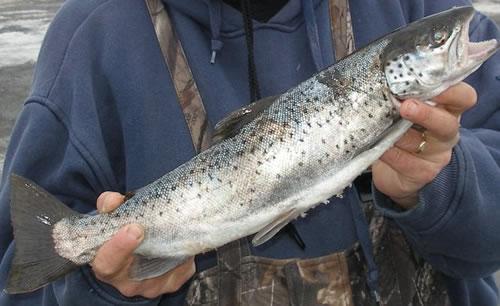
Atlantic salmon are non-native to Washington, but can be found in the state's marine waters at several commercial fish farms, where the fish are raised for the seafood market in enclosed net pens.
Occasionally, some of these fish escape from their holding pens and may be caught by anglers and commercial and tribal fishers.
The Washington Department of Fish and Wildlife (WDFW) considers Atlantic salmon an aquatic invasive species, but there is no evidence to date that Atlantic salmon pose a threat to native fish stocks in Washington through crossbreeding or disease.
Anglers are not required to record Atlantic salmon on their catch cards.
Invasive species information
- Atlantic salmon (Salmo salar) are important worldwide in commercial aquaculture and recreational fisheries and are cultured commercially in marine net pens in Puget Sound.
- The Washington Department of Fish and Wildlife (WDFW) examined potential threats that escaped Atlantic salmon could pose to native species in a 1999 report, "Atlantic Salmon in Washington State: A Fish Management Perspective."
- Commonly expressed concerns surrounding escaped Atlantic salmon include competition with native salmon, predation, disease transfer, hybridization, and colonization.
Based on WDFW's study, the evidence strongly indicates that Atlantic salmon aquaculture poses little risk to native salmon and non-salmon species.
Historical Background
- Numerous attempts were made in the 20th century by agencies on the Pacific coast to introduce and establish Atlantic salmon. The most recent effort by WDFW was in 1981, when attempted introductions were made via the release of cultured Atlantic salmon smolts. No adult Atlantic salmon returned as a result of the releases.
- In 1990, at the direction of the Legislature, WDFW published a programmatic environmental impact statement of net pen aquaculture. Risk to native fish by Atlantic salmon was determined to be low.
- Before 1996, no significant escapes of Atlantic salmon from pens in Washington were recorded. In 1996, 1997, and 1999 there were large escapes of approximately 107,000, 369,000, and 115,000 fish, respectively. In 2017, more than 100,000 fish escaped when a net pen facility containing about 305,000 fish failed near Cypress Island.
- Between 2003 and 2008, WDFW's Aquatic Invasive Species Unit conducted 882 surveys for the presence of Atlantic salmon across 174 water bodies, and collected 192 Atlantic salmon. An analysis of otolith and scale samples strongly indicated that all of the captured juvenile fish were hatchery escapements and all of the adults were net pen escapees. There was no direct evidence of Atlantic salmon spawning or hybridized specimens.
Roles and responsibilities
Permitting and oversight of aquaculture operations in Washington waters involves multiple state agencies. These relationships include WDFW's co-management of salmon and other species with the state's treaty tribes. Here is a summary of key state agency roles:
- Department of Ecology
Ecology manages the state water quality permits required for commercial net pen operations. - Department of Fish and Wildlife
WDFW reviews permit requirements, fish escape prevention and response plans, and monitors the health of farm-raised fish in collaboration with the Northwest Indian Fisheries Commission fish health group. The department also requires fish transport permits to ensure fish are not at risk of disease. - Department of Natural Resources
DNR owns aquatic lands on which aquaculture operations take place, and leases those lands to operators. - Counties of Washington state
Counties issue shoreline permits to net pens.
Fish management issues of escaped Atlantic salmon
Existing biological data strongly suggests that escaped Atlantic salmon do not pose significant risk to native fish populations, based on research outlined in a 1999 report. Among the concerns addressed in that report:
- Competition: Evidence indicates non-native salmon species do not compete well against native species. Only a small percentage of Atlantic salmon recovered from marine waters have preyed on fish; there have been no observations of Atlantic salmon eating fish or fish eggs in fresh water.
- Predation: There is no evidence of predation by Atlantic salmon in fresh water, and only limited evidence in salt water. Most recovered Atlantic salmon have had empty stomachs.
- Disease transfer: Consideration was given to the transfer of fish pathogens from captive and escaped Atlantic salmon to native salmon stocks. There is no evidence indicating disease transfer from Atlantic salmon to native Pacific salmon. Fish pathogens infecting Atlantic salmon are endemic to Washington and appear to come from native fish stocks.
- Hybridization: The risk of escaped Atlantic salmon hybridizing with Pacific salmon is low. Research has demonstrated it is very difficult, even under optimal laboratory conditions, to cross-breed Pacific and Atlantic salmon and produce viable offspring. Should this rare event occur in the wild, the offspring would be functionally sterile and incapable of reproducing.
- Colonization: Evidence suggests this is unlikely. Attempts to establish Atlantic salmon outside the Atlantic Ocean have failed, and accidental releases of juvenile Atlantic salmon have not produced adults. Evidence on Vancouver Island indicates escaped Atlantic salmon have been able to produce juvenile Atlantic salmon, but there is no evidence that these "wild" Atlantic salmon have returned to their natal stream and successfully spawned.
Results from WDFW's 2003-2008 Atlantic Salmon surveys supported these conclusions.
Description and Range
Physical description
Atlantic salmon typically measure 28 to 30 inches and weigh 8 to 12 pounds after two years at sea. They have a number of features to distinguish them from wild salmon:
- Large black spots on the gill cover. Neither Pacific salmon nor steelhead have this feature.
- The dorsal, ventral, and tail fins of Atlantic salmon may be eroded or worn from containment in net pens.
- The tail fin is flatter than the notched fin found on wild salmon.
State record
| Weight | Angler | Location | Date Caught |
|---|---|---|---|
| 8.96 lbs | Gregory Lepping | Goat Lake, Jefferson County | September 13, 1992 |