Geographical range:
Baja California, Mexico, to the Bering Sea and northeast to the Beaufort Sea.
Also along the Asian coast from the Arctic Ocean to Japan.
Related species: Common local members of the herring family, Clupeidae, are the Pacific sardine, (Sardinops sagax) and the American shad, (Alosa sapdissima). Other forage fish species include surf smelt, sand lance, and anchovy.
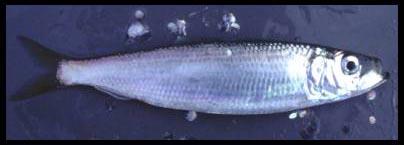
Life history: Most Washington State herring stocks spawn from late January through early April. The notable exception is the Cherry Point stock (the largest in the state), which spawns from early April through early June. Herring deposit transparent, adhesive eggs on intertidal and shallow subtidal eelgrass and marine algae. Eggs may be deposited anywhere between the upper limits of high tide to a depth of -40 feet, but most spawning takes place between 0 and -10 feet in tidal elevation. Eggs hatch in about 14 days, producing slender, transparent larvae about 13 mm long. At this stage, they are at the mercy of currents and subject to heavy predation by larger organisms. At about three months of age and at about 38 mm in length, herring metamorphose into their adult form and coloration. They will mature and return to their spawning ground in their second or third year. Herring do not normally die after spawning, and continue to spawn in successive years.
Natural mortality is quite high, approximately 50-70 percent of the adult herring from Washington will fall to predation each year. Thus, the typical Puget Sound herring is relatively short lived, rarely surviving beyond age five. Some herring stocks appear to have an annual migration from inshore spawning grounds to open ocean feeding areas, while others appear to be more "resident", remaining inside the Puget Sound basin year around. Adult herring feed primarily on planktonic crustaceans, and in turn are food for many marine animals such as seabirds, marine mammals, and other fishes.
Spawning stocks: Herring stocks are defined by spawning grounds. At least 18 stocks spawn inside Puget Sound and one on the Washington coast in central Willapa Bay. Spawning has been reported but not documented in the Columbia River estuary near the Illwaco and Hammond. The approximate location of spawning grounds inside Puget Sound and those spawning grounds grouped by stock are pictured in the figure below.
(Documented herring spawning grounds GIF , 24k.)
Although homing is not absolute, and is less specific than that demonstrated by salmon, herring spawning populations appear to maintain some biological separation from each other. Each geographically distinct spawning population is defined as a discrete stock. Other stock specific characteristics such as unique age structures, distinctive spawning timing and prespawner holding area behavior support the stock definitions.
The adjacent chart shows, in yellow, the approximate location of the documented herring spawning grounds in Puget Sound. Herring populations which spawn each year at these individual grounds form the 18 stocks. Each stock in Puget Sound is assessed annually by one of two assessment methods. The annual assessments are published each year in the Stock Status Report.
The Pacific herring is of considerable interest to the citizens of the Puget Sound region because of the species' value as forage, its popularity as recreational fishing bait, its significance to local commercial fisheries, and its importance as an indicator of the general "health and productivity" of Puget Sound.
For management planning, Washington is divided into four geographic regions: South-central Puget Sound, north Puget Sound, Strait of Juan de Fuca and the Washington coast. Profiles have been developed for known herring stocks within these geographic regions. These profiles are detailed in the Stock Status Report.
Herring were included in the 1974 "Boldt Decision" regarding Native American fishing rights, and local stocks and fisheries are cooperatively monitored and managed by Washington Department of Fish and Wildlife (WDFW) and local area Tribal governments.
The appropriate harvest rate for herring has been shown to be about 20 percent of the spawning stock, and herring are harvested at that rate worldwide. Significant fisheries for herring also occur in Alaska, British Columbia, Oregon and California. (To learn more about Canadian herring management visit their web site at DFO Canada.) Presently, Puget Sound herring are fished at an extremely conservative level; at a total annual exploitation rate of about 6 percent. Two commercial herring fisheries occur in Washington, both in Puget Sound: A sport bait fishery and a spawn-on-kelp fishery.
The sport bait fishery occurs primarily in the South-central Puget Sound Region and is assumed to exploit an aggregate of stocks within the region. The fishery is regulated by area, season, gear type, and harvest guidelines. Harvest guidelines are generally based on an annual average of the pooled South-central Puget Sound stock biomass estimates.
The spawn-on-kelp fishery is currently limited to specific north Puget Sound spawning stocks. The fishery is managed among WDFW and four tribes. A Herring Technical Team, comprised of representatives from the management bodies, is responsible for developing annual management plans that include run forecasts, harvest guidelines, and fishery protocols. The fishery is regulated by area, season, gear type and harvest guidelines. Harvest guidelines are based on annual stock biomass estimates.
In 1973, the Washington State Legislature enacted limited entry for non-treaty commercial herring fishing. The maximum number of herring fishing licenses was "frozen" for each gear type (dipbag, lampara seine, purse seine, beach seine and gill net). Anyone interested in commercially fishing for herring must purchase an existing license from a current license holder. The treaty herring fishing fleet is not under growth restriction, although fishing effort is limited by management plans defined by the Herring Technical Team.
Two methods are used by WDFW to provide quantitative estimates of herring abundance: spawn deposition surveys and acoustic/trawl surveys. Using one of either of the two methods, WDFW currently estimates the abundance (spawning biomass) of each of the 18 recognized herring stocks in Puget Sound each year. Occasional assessments are conducted on the Washington coastal stock.
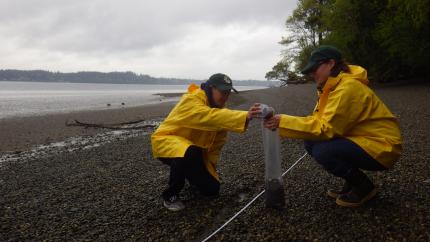
Spawn deposition surveys provide a direct estimate of herring spawning abundance measured as biomass. The marine vegetation on documented herring spawning grounds is sampled for the presence of herring eggs. If eggs are present their density and coverage is estimated and that data is converted to an estimate of spawning escapement. These surveys are generally conducted weekly during a stock's spawning season to document cumulative spawn deposition.
Acoustic/trawl surveys are conducted on the prespawner holding areas. Prior to spawning, ripening adult herring congregate and hold in a region usually adjacent to the spawning grounds. In the adjacent drawing, the spawning ground is shown in pink and the holding area in blue. The schooling process usually begins 3-4 weeks before the first spawning event. Acoustic/trawl surveys are conducted early in the spawning season when holding area stock abundance peaks. This method utilizes echosounding equipment (sonar) with a computer interface. The acoustic gear produces a real-time estimate of total fish abundance. The estimate of total fish abundance is apportioned to herring biomass based on data collected by a mid-water trawl which samples the schooling fish. Analyses of the trawl catch also provides herring size, age, and maturity data.
Annual estimates of herring spawning stocks size can vary greatly between years and spawning grounds for a variety of reasons unrelated to fishing pressure. The best indicator of overall herring viability for each of the four regions is the cumulative estimate of all stocks that spawn within each region. Any extensive environmental changes or deleterious factors resulting in a negative impact on herring productivity would readily become apparent by trends in these cumulative regional estimates.
Of the four management regions, the South-central Puget Sound combined stock spawning biomass has shown the least variation during the 20 year time frame presented in the figure below. The cumulative spawning biomass for the period is 6,059 tons.
The cumulative north Puget Sound spawning biomass has typically been the largest within the state. From the period 1975 through 1983, the standing spawning biomass exceeded 10,000 tons each year, primarily because of large Cherry Point stock estimate. The period 1984-1987 saw a substantial decline in the biomass, again largely related to a decline in the Cherry Point stock estimates. From 1988 to 1994, a gradual increase in total spawning biomass has taken place, and then a decline in 1995 and 1996. All stocks in the region have, to some degree, contributed to this escalation.
The Strait of Juan de Fuca collection of stocks contains the smallest spawning biomass among the four regions. Discovery Bay is the location of the predominant stock. From the mid 1980s to the present, stock estimates from this region have shown a continuing decline. The reason for the decrease in abundance is unknown. Commercial landings from the area during the 1977-96 period have been insignificant and no known major environmental changes in the area have occurred.
The cumulative total Puget Sound spawning biomass for the 1977-96 period is 15,994 tons. Annual cumulative estimates above 15,000 tons are presently considered the baseline level for a healthy regional herring population. During three of the last five years the total cumulative estimate has exceeded or been within five percent of the baseline. The 1996 cumulative estimate of 12,966 tons falls below this threshold.
While spawning populations of herring are known to occur in the Washington coastal region, only occasional monitoring or assessment of coastal herring currently takes place. Variable spawn deposition survey effort in Willapa Bay during 1974, 1988, 1989 and 1997 suggest a spawner escapement ranging from 50 to 700 tons.
Herring spawning stock size fluctuations are primarily influenced by ecological factors that affect survival, and to a smaller extent growth. Changes in sea temperature, for example, can affect herring food supplies and or change the abundance of predators.
With appropriate stock assessment methodology, survival and mortality can be estimated. Mortality can be divided into two types: fishing and natural mortality (all causes other than fishing). An annual estimate of herring mortality in Washington has been calculated since 1976. The figure below shows the annual mortality experienced by all adult Puget Sound herring combined. For the purpose of this figure, it is assumed that the cumulative spawner biomass estimate is reflective of the total spawner biomass and that variation in annual mortality between stocks is small.
The annual natural mortality rate estimates for herring in Puget Sound have increased from the 30-40 percent range in the 1970s to the 60-70 percent range at present. Worldwide, natural mortality rates in the 30-40 percent range are considered typical, while higher rates, like those presently observed for the Puget Sound stocks are considered unusual. Relatively good two year old recruitment in recent years has been sustaining most stocks in Puget Sound despite high natural mortality rates. Recruitment failure, under the present natural mortality, would lead to dramatic stock biomass declines.
The adjacent graph indicates that in the last 20 years, herring natural mortality has increased while fishing mortality has decreased. Therefore, declines in herring abundance can most likely be attributed to increased predation. Increases in some herring predators, such as harbor seals, California sea lions and mackerel may contribute significantly to herring population declines. Similarly environmental changes may contribute to the increase in natural mortality.
The location of herring spawn deposition in lower intertidal and upper subtidal habitats and the geographically specific nature of herring spawning behavior makes herring spawning grounds vulnerable to shoreline development. Documented herring spawning grounds are protected from habitat loss by the Washington Administrative Code Hydraulic Code Rules.
Each herring spawning ground is assumed to represent a discrete stock. WDFW's ongoing assessment survey results, which indicate stock specific age structures, and strong site specificity, spawn timing, and prespawner holding area characteristics continue to support the assumption of stock autonomy for Puget Sound herring. Therefore, conservation of herring spawning habitat, and minimizing disturbance in the prespawning holding areas is key to the preservation of the herring stocks inside Puget Sound. Herring stock assessment data is very useful for localized habitat management and planning.
In Washington, the majority of commercial herring fisheries have historically occurred inside Puget Sound. There are no directed fisheries on any herring populations on the Washington coast. From the early 1930s until the late 1950s, herring caught commercially in Puget Sound were primarily used as bait for halibut, crab, and shark fisheries. During the early 1950s, fishing emphasis began shifting to supply bait needs for a rapidly growing recreational salmon fishery. In addition, beginning in the late 1950s over all herring catches rose substantially due to an expanding reduction fishery in north Puget Sound that processed herring into fish meal.
In 1972, a large scale fishery for herring sac-roe began in the Strait of Georgia (north Sound region ). Total landings of herring in Puget Sound peaked by the mid-1970'. Harvest levels decreased in the late 1970' when north Puget Sound stocks began to decline, and both the reduction fishery and the sac-roe fishery were closed in the early 1980s.
Currently, WDFW is responsible for the management of two commercial herring fisheries in Washington: the sport bait fishery and the spawn-on kelp fishery. The sport bait fishery is the principal commercial herring fishery which occurs primarily in the South-central Puget Sound region. Annual landings from 1992-96 averaged 510 tons, with most of the harvest taken by small (200 foot) lampara seines. This predominately non-treaty fishery targets 1-1/2 year old "plug" herring almost exclusively.
The spawn-on-kelp fishery (treaty and non-treaty) predominantly occurs in the north Puget Sound region, although occasionally a small treaty only spawn-on-kelp fishery is conducted in central Puget Sound. In this fishery, purse seines capture herring which are congregating in the prespawning holding areas. The fish are impounded in floating pens hung with lines of kelp; (Macrocystis integrifolia). The impounded herring spawn on the kelp, and then are released, and the spawn laden kelp is harvested. In a variation of this fishery, the kelp is hung from floating lines near the spawning beaches where it is spawned upon by fish which are not impounded. The combined treaty/non-treaty spawn-on-kelp fishery has averaged 241 tons of fish impounded or utilized per year.
Recreational landings of herring in Washington State are relatively insignificant. Sport anglers occasionally jig herring or dip herring "balls" for salmon bait, but most purchase commercially caught bait herring. Herring are also commonly caught incidentally in surf smelt recreational jig fisheries, and some are likely kept and consumed.
| Go
to the top of this document |
Go
to the Forage Fish Index Page |
Go
to the WDFW Home Page |
E-mail: fishpgm@dfw.wa.gov